


POLE SHAFTS
Description
A pole shaft, also known as a salient-pole generator shaft, is the main rotating mechanical structure of a synchronous generator. It supports the magnetic pole structure, transmits torque, and maintains alignment between the bearing, rotor, and exciter axes.
These shafts are used in hydroelectric plants and other power plants to convert mechanical energy into alternating current electrical energy, and also in industrial systems, synchronous condensers and grid-support applications.
At Ismec, pole shafts are commonly classified as 4-pole, 6-pole, or 8-pole shafts according to the number of magnetic poles with pole shoes arranged on the rotor body. The number of poles defines the electromagnetic architecture and influences synchronous speed, pole geometry, drilling patterns, winding layout, mass distribution, and rotor core configuration.

Function and Features
During operation, the rotor shaft supports and carries the magnetic pole structure inside the stator.
As the rotor turns, the magnetic field generated around the poles interacts with the stator windings, enabling electrical energy generation.
Indeed, the pole shaft is a rotating body and the mechanical structure that allows the magnetic field to rotate in a stable and centered way.
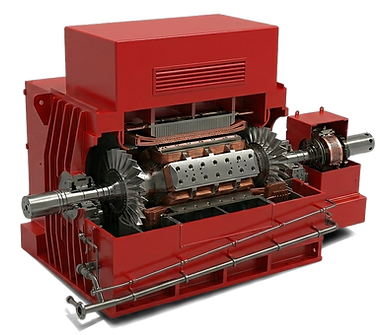
A pole shaft normally features a massive central rotor body, DE (drive end) and NDE (non drive end) ends. Moreover, there are usually coupling flanges, bearing journals, pole seats, long longitudinal slots, keyways and threaded or auxiliary holes.
These are large and heavy components, often weighing several tons. For this reason their production requires careful handling, lifting, alignment, setup, and machine preparation. Ismec’s experience in large-scale machining allows these operations to be effectively planned and managed.
Pole shafts require reliable forged materials, because they must withstand rotation, fatigue, vibration, centrifugal forces, torsional loads, and bending stresses. Typical solutions include for example 34CrNiMo6 and 42CrMo4, or customer-specified steels.

COUPLING FLANGE
BEARING JOURNAL
FAN MOUNTING SEAT
THREADED FIXING HOLES
BEARING JOURNAL
KEYWAY
POLE SEATS
CNC Machining of Rotor Shaft and Pole Shoes
The production of a pole shaft requires a controlled sequence of CNC turning and CNC milling, rough machining, drilling, tapping, finishing, grinding, and testing.
The key challenge is maintaining strict tolerances and concentricity control, in addition to surface finish, and geometric coherence between axis and poles position. This accuracy is essential to support mechanical strength, dynamic stability, balancing, and correct air-gap control between rotor and stator.
Ismec can also support the production, machining, and installation of pole shoes.
Main purposes of pole shoes is to distribute magnetic flux and improve the shape of the magnetic field in the air gap. Depending on the machine design, pole shoes may be mounted on the rotor body through mechanical fixing systems, or the poles may be directly machined from the forged rotor body.
The separately machined and assembled pole shoe solution offers greater modularity and flexibility, especially when maintenance or optimization are priorities. By contrast, integral poles machined directly from the forged rotor body provide higher structural robustness, reduce mechanical interfaces, and minimize risks related to screws, locking systems, and differential thermal expansion.
Final inspection is a crucial part of pole shaft manufacturing.
Typical controls include dimensional inspection, run-out and bearing journal checks, roughness measurement, thread and hole-position inspection, UT, MT/PT testing, and complete quality documentation.
Here are some examples of Salient-Pole Generator Shafts


